






 Quick Add
TETRA FAQ
TETRA Interference and TV Reception
TETRA, Terrestrial Trunked Radio, is a digital mobile radio system used by emergency services, transport networks and other professional communication services. In some locations, strong TETRA transmissions can affect television reception if the aerial system is not sufficiently protected against out-of-band signals.
The most effective way to reduce TETRA interference is to use good installation practice, screened components and suitable filtering before any amplifier in the signal chain.
What is TETRA?
TETRA is a digital mobile radio system used for voice and data communications. It replaced many older analogue private mobile radio systems, particularly across larger networks.
In the UK, TETRA has been adopted by police forces, emergency services and other professional users. TETRA base stations operate in many locations across the UK and Republic of Ireland. They are similar in principle to mobile phone base stations, but often use larger cells and higher transmission powers.
Why Can TETRA Cause TV Interference?
TETRA base stations usually transmit in the 390 to 400 MHz frequency band, just below the UHF TV band. Where a TETRA base station is close to a property, especially in urban areas, the television aerial may be exposed to high interfering field strengths.
Even though the TETRA signal is outside the wanted TV band, it can overload the input stages of a receiver, masthead amplifier or distribution amplifier. This can cause effects known as intermodulation and blocking, which can degrade or disrupt television reception.
What Does TETRA Interference Look Like?
The appearance of TETRA interference can vary considerably. On analogue pictures it was often described as horizontal patterning or "tyre tracks" across the picture. On digital television, interference may appear as blocking, freezing, pixelation or complete signal failure once the interference becomes severe enough.
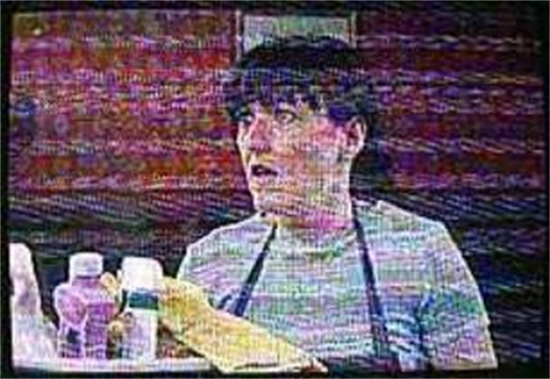
Digital television can appear normal until the available reception margin is eroded. Once the signal falls below the required threshold, reception can fail quickly.
When is TETRA Interference Most Likely?
The risk of TETRA interference increases when one or more of the following conditions apply:
- A TETRA mast is within a few kilometres of the installation.
- The TV aerial is vertically polarised.
- The TV aerial is Group A, Group K, Group T or wideband.
- A masthead amplifier is in use, especially a high-gain type.
- There are multiple amplifiers or excessive overall gain in the system.
- The wanted TV field strength is already poor.
Does TETRA Affect Digital TV?
Yes. However, because of the digital cliff effect, lower levels of interference may not be visible immediately. As the reception margin is reduced, the picture may suddenly begin to break up, freeze or disappear completely. Even if reception appears stable, lower-level interference can reduce protection against other issues such as multipath, co-channel interference or variations in signal strength.
Whose Responsibility is it?
TETRA interference is usually caused by a receiving installation having insufficient immunity to strong out-of-band signals. This generally means the householder, building owner or owner of the TV distribution system is responsible for improving the installation to reject the unwanted signal.
What Can Be Done?
The main defence against out-of-band interference is filtering. In many older systems, UHF masthead and distribution amplifiers used only basic input filtering, giving little or no rejection in the 390 to 400 MHz TETRA transmit band.
In existing installations, TETRA interference can often be reduced or removed by fitting a suitable filter, such as a UHF high-pass or band-pass filter, before any active equipment in the signal chain.
Where an amplifier is used, the filter should normally be fitted before the amplifier, not after it.
New Installations
With the VHF and UHF spectrum becoming increasingly crowded, new installations should be designed to reject strong out-of-band signals wherever possible. Installers should avoid amplifiers with wide-open or poorly filtered inputs.
Many PROception amplifier products include built-in Airwave TETRA filtering at the front end. This typically provides around 30 dB rejection at 400 MHz and below, helping make installations more resistant to TETRA interference in all but the most severe locations.
Filtered amplifiers should still be combined with good installation practice, including screened components throughout, CAI benchmarked or certified cable, correct signal levels and avoiding excessive amplifier gain.
PROception Products with Built-in TETRA Filtering
The following PROception products include built-in filtering to help reduce the risk of TETRA-related interference.
| Product Codes | Description |
|---|---|
|
PROAMP24 PROAMP28 |
4-way and 8-way TV and FM aerial distribution amplifiers. |
|
PROAMP24R PROAMP28R |
4-way and 8-way TV and FM distribution amplifiers with return path for Sky™ remote control. |
|
proMHD11L proMHD11M proMHD11H |
Low, medium and high-gain UHF masthead pre-amplifiers. |
|
proMHD12M proMHD14M |
2-way and 4-way UHF masthead fixed gain amplifiers. |
| Variable gain masthead amplifiers | 1-way and 4-way UHF masthead variable gain amplifiers. |
|
PROAMP104X PROAMP310X |
4-way and 10-way Dual Mode distribution amplifiers. |
Always use the lowest gain amplifier necessary to obtain satisfactory reception.
Installation Good Practice
- Use screened components throughout the system.
- Use CAI benchmarked or certified coaxial cable where possible.
- Avoid excessive amplifier gain.
- Fit TETRA filtering before any masthead or distribution amplifier where interference is suspected.
- Use filtered amplifiers in areas where strong out-of-band signals may be present.
- Check signal levels and avoid overloading receivers or amplifiers.
References
Acknowledgements
Interference example image reproduced with the kind permission of Wright's Aerials.