






 Quick Add
Installation Options
Aerial Installation Options for Locating and Fixing
In a typical house or dwelling, there are several options for installing a TV aerial, mast and bracket. The most suitable fixing method will depend on the property, signal path, available mounting points and safe access.
Always assess the installation location, signal direction and height safety risks before starting work. If in doubt, seek professional advice.
Loft Installation
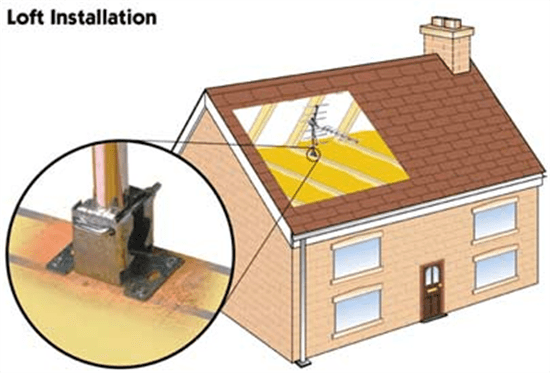
Loft installations can be suitable where external mounting is not possible, but signal levels may be reduced by roof materials, water tanks, internal walls and other objects within the roof space.
- Avoid installing the aerial in the centre of the loft space, where reflected signals are more likely.
- Do not point the aerial towards water tanks or header tanks, as these can significantly reduce signal level.
- Avoid pointing the aerial towards side walls; where possible, point the aerial through the roof tiles towards the transmitter.
- If possible, tilt the aerial back slightly to help improve reception.
- If in doubt regarding height safety or loft access, seek professional advice.
Fascia Installation
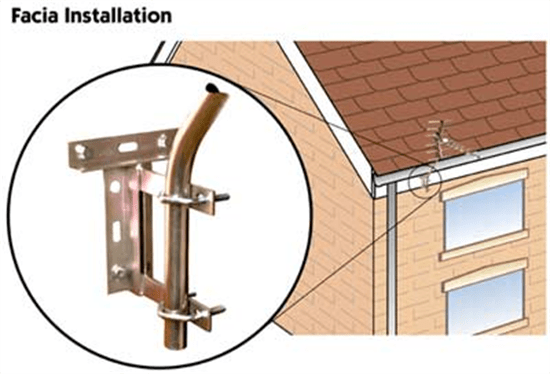
A fascia installation can be useful where a discreet fixing position is required, but it usually provides less flexibility for alignment than chimney or wall mounting.
- This option offers limited aerial alignment flexibility.
- It is generally suitable only where there is a clear line of sight to the transmitter.
- Always check that the fascia is structurally suitable before fixing any bracket or aerial.
- If in doubt regarding height safety, seek professional advice and do not take unnecessary risks.
Chimney Installation
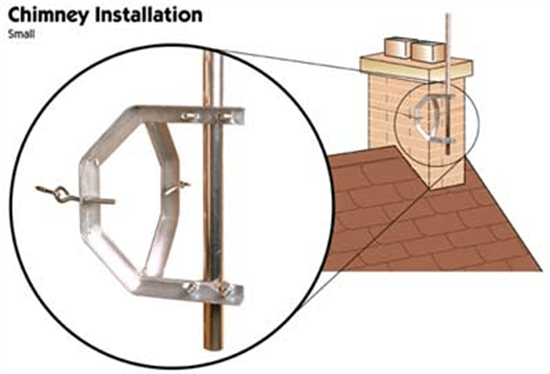
Chimney mounting is often one of the most effective aerial installation options because it can provide good height and a clearer signal path without always requiring a long mast.
- This is often the best option for achieving maximum height without using a long mast.
- On larger chimneys, a longer mast may be installed using a double chimney bracket method.
- The double bracket method is also suitable for medium or large aerials, where a standard single chimney bracket may be vulnerable in high winds.
- Do not install a chimney bracket unless the chimney is structurally sound.
- If in doubt regarding height safety, chimney condition or fixing method, seek professional advice.
Wall Installation
|
|
|
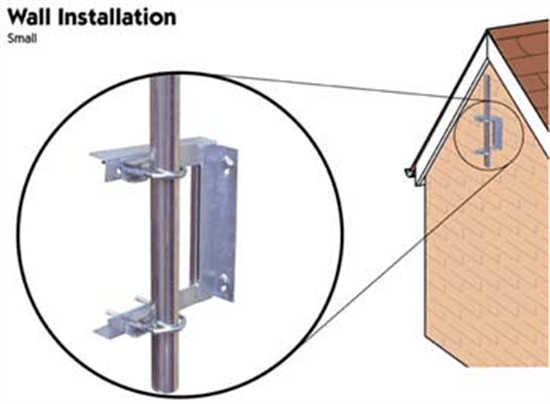
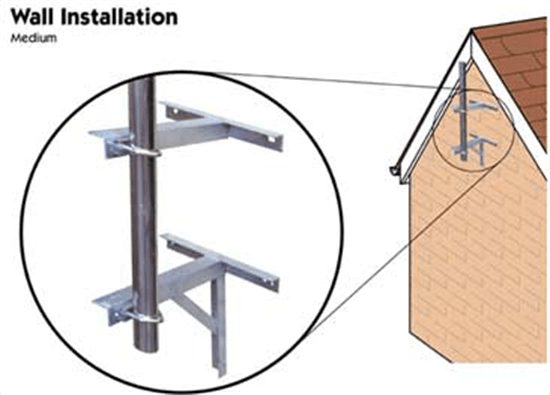
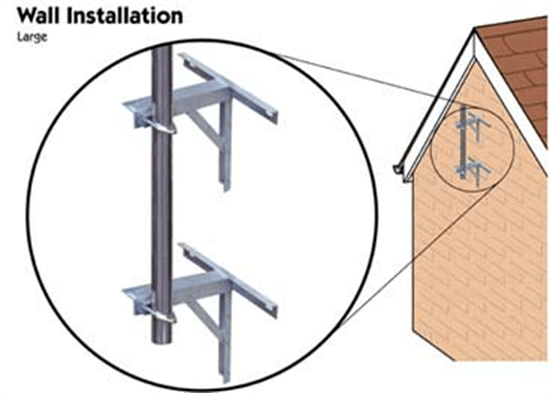
Wall mounting is usually the best option for properties without a chimney. The correct bracket size and mast arrangement should be chosen based on the installation height, aerial size, wind loading and line of sight towards the transmitter.
- This is often the best option for a property without a chimney.
- If a longer-than-usual mast is required, the double wall bracket method is usually preferred.
- Choose the wall that gives the aerial the best line of sight towards the transmitter.
- Check the wall structure and fixing surface before drilling.
- If in doubt regarding height safety or fixing method, seek professional advice.
Health and Safety
Your health and safety must come first. Determine the installation type, assess the risks and use the correct access equipment before starting any work.
Loft Installation
- Is access to the loft secure and safe?
- Are roof boards fitted securely for safe movement within the roof space?
- Is there adequate visibility, or will additional lighting be required?
Chimney Installation
- Can the chimney be accessed safely using a suitable ladder and roof ladder?
- Is the chimney in good condition and able to withstand the stresses of a bracket and aerial?
- Is the ground level for the ladders, or will secure packing be required?
- Are there suitable points where ladders can be secured?
Wall Installation
- Can the wall be accessed safely?
- Can the ladder be secured to a fixed point?
- Is the ground level for the ladders, or will secure packing be required?
- Check that drilling will not damage pipework or electrical cables.
- Consider both the bracket fixings and any cable routing through the wall.
General Safety Precautions
Do
- Plan the installation and identify the equipment required before starting work.
- Be aware of other people at ground level.
- Use good-quality ladders with non-slip feet and check for defects before use.
- Position ladders so they are securely footed and do not lean sideways.
- Use the correct ladder angle, approximately 4 vertical to 1 horizontal.
- Ensure the work can be reached from a safe position below the top of the ladder.
- Keep one hand on the ladder wherever possible.
- Ensure ladders rest against a solid surface, not fragile materials such as plastic guttering.
- Use a second person to foot the ladder where it cannot be fixed securely.
- Use a suitable roof ladder when working on sloping roofs.
- Carry tools in a shoulder bag or tool holster.
- Use warning signs, cones or barriers where ladders are used in thoroughfares.
- Lay temporary floorboards when working in the loft.
- Take time on the installation and avoid carrying too many items up the ladder in one trip.
- Wear appropriate safety equipment such as harnesses and fall-arrest equipment where required.
Do Not
- Do not work on unsafe structures. If the structure appears unsafe, seek professional advice.
- Do not work alone.
- Do not use damaged ladders or equipment.
- Do not use makeshift or home-made ladders, or carry out makeshift ladder repairs.
- Do not use painted ladders, as paint may hide faults.
- Do not stand on roof tiles unless absolutely necessary; use a roof ladder or creeper board.
- Do not fix ladders on uneven ground without secure levelling.
- Do not climb or work from a ladder unless you can hold onto it safely.
- Do not use the top platform of a stepladder unless it is designed for that purpose.
- Do not carry items up a ladder if both hands are required.
- Do not work on a sloping roof without a suitable roof ladder or creeper board.
- Do not use wall-type brackets on chimneys; use brackets designed for strapping or lashing fixings.
- Do not fit chimney brackets to the top courses of chimney brickwork; use lower, structurally sound courses.
- Do not throw equipment to ground level. Carry old brackets, cables, poles and aerials down safely.
- Do not modify safety equipment without the manufacturer's prior agreement.
If in doubt regarding any aspect of height safety, always seek professional advice and never increase the risks by taking chances.