






 Quick Add
Galvanising
Which Protective Finish Do I Need on My Brackets?
Steel aerial support brackets are exposed to wind, rain and changing weather conditions throughout their service life. Choosing the correct protective finish helps improve corrosion resistance, reduce maintenance and extend the life of the installation.
For external aerial, satellite and mast installations, hot-dip galvanised brackets are generally the preferred option for long-term corrosion protection.
Common Protective Finishes
There are several ways to protect steel from weathering and corrosion. Common finishes used on aerial support brackets include painting, zinc electroplating with passivisation and hot-dip galvanising.
Painted Finish
Painting can be a low-cost method of protecting steel, but it usually provides weaker long-term corrosion protection than galvanising. One industrial method involves immersing the component in a specialist coating formulation, often following a de-greasing process, before draining and drying naturally or through oven-assisted drying.
Zinc Electroplating and Passivisation
Electroplated zinc with passivisation, sometimes referred to as zinc and passivisation, can provide good initial protection but has a more limited outdoor service life. Electroplated coatings are thin and will gradually corrode away, often in under ten years depending on exposure conditions.
Chromate passivisation is a chemical post-treatment commonly used with electroplated zinc finishes. It can produce the familiar green-yellow appearance, while thinner treatments can give a white or shiny finish. Although passivisation can improve corrosion performance in salt spray testing, it does not greatly extend the outdoor life of aerial brackets compared with hot-dip galvanising.
Hot-Dip Galvanising
Hot-dip galvanising is the process of dipping steel components into molten zinc after chemical cleaning and pre-treatment. The zinc reacts with the steel to form inter-metallic alloy layers, creating a strong metallurgical bond between the steel substrate and the zinc outer surface.
A hot-dip galvanised coating is significantly thicker than a passivated electroplated zinc finish and therefore provides a much longer service life. A galvanised bracket or mount offers superior protection against rust, staining and structural deterioration.
Brackets and mounts supporting substantial weight should ideally be galvanised. This helps maintain weld integrity, extend product lifespan and improve resistance to environmental exposure, especially where wind loading from an aerial, dish or mast is a factor.
Installer Guidance
Section 17 of the CAI Code of Practice for installing terrestrial and satellite TV reception systems states that hot-dip galvanised brackets should always be used. This ensures the installer can be confident that the correct protective finish has been selected for external use.
Inferior finishes can lead to premature rusting once the protective coating has failed. This may cause unsightly staining to brickwork and masonry and can reduce the service life of the installation.
The Zinc Millennium Map Project
The Zinc Millennium Map Project investigated the background atmospheric corrosion rate of zinc coatings across the UK and Republic of Ireland. It showed how reductions in atmospheric sulphur dioxide levels have helped increase the life expectancy of hot-dip galvanised coatings.
Hot-dip galvanising offers a strong combination of long-term reliability, coating toughness and low lifetime cost, making it one of the most effective corrosion protection systems for steel aerial brackets and support products.
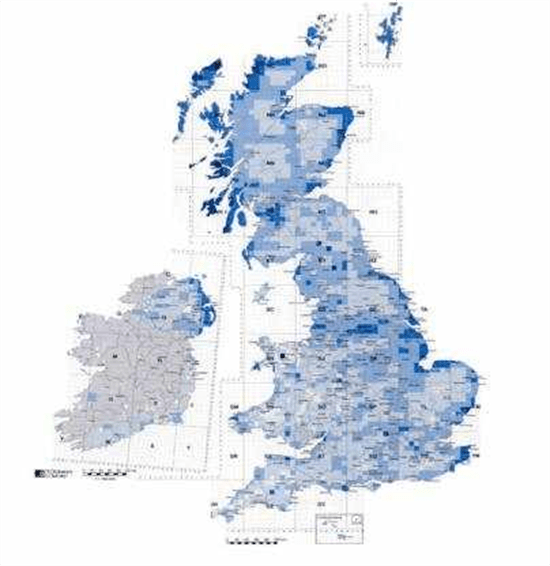
The table below shows expected lifetimes for galvanised and electroplated zinc coatings across the five corrosion categories shown in the map.
Expected Coating Lifetimes
| Corrosion Category | 1 | 2 | 3 | 4 | 5 |
|---|---|---|---|---|---|
| Average corrosion rate | 0.5 µm/year | 1 µm/year | 1.5 µm/year | 2 µm/year | 2.5 µm/year |
| Life - galvanised 55 µm | 110 years | 55 years | 37 years | 28 years | 22 years |
| Life - zinc and passivisation 8 µm | 16 years | 8 years | 5.3 years | 4 years | 3.2 years |
| Life - zinc and passivisation 5 µm | 10 years | 5 years | 3.3 years | 2.5 years | 2 years |
Data for painted finishes is not available.
Figures above are based on a typical 3 mm steel product.
Further Information
For further information about galvanising and zinc coating performance, please refer to the Galvanizers Association.
Acknowledgements
- CAI, Confederation of Aerial Industries.
- The Galvanizers Association.
Note: Annual average atmospheric corrosion of zinc, UK and Republic of Ireland, 1998-2000.