


 Quick Add
COM7, Aerials, Amplifiers and Filters
There has been a recent announcement that the remaining interim multiplex (mux) on channel 55, also known as COM7, was switched off at the end of June 2022. After this date, all DTT multiplexes will be transmitted using only channels 21 to 48.
We thought looking at the implications for aerials, amplifiers and filters would be helpful.
Important: This page contains technical guidance relating to COM7, LTE, spectrum clearance, aerial groups, amplifiers and filters. Technical wording has been retained for reference purposes.
Aerials
An aerial covering a small range of channels can be expected to have higher gain than an aerial of comparable size but covering a wide range of channels. Therefore, many years ago groups A, B, C/D, E and W were defined. More recently, groups K and T have been added to account for the clearance of the 700 MHz and 800 MHz bands.
| Group | Channels | Colour code | Install after June 2022? |
|---|---|---|---|
| A | 21 - 37 | Red | Yes |
| B | 35 - 53 | Yellow | No |
| C/D | 48 - 68 | Green | No |
| E | 35 - 68 | Brown | No |
| K | 21 - 48 | Grey | Yes |
| T | 21 - 60 | White | No/Yes# |
| W | 21 - 68 | Black | No |
With the first phase of spectrum clearance, TV transmissions in the 800 MHz band (channels 61 to 68) were moved to lower channels and replaced by high-power LTE base stations. These base stations are capable of creating very high signal levels at the aerial output, which can interfere with TV reception.
In the second phase, TV transmissions in the 700 MHz band (channels 49 to 60) were moved to lower channels. The widespread deployment of further base stations for mobiles will be underway shortly.
To help protect amplifiers and receivers from harmful interference, it is strongly recommended not to use an aerial where the range of channels it is designed to work with covers any part of the cleared 700 MHz and 800 MHz bands. Normally, the gain of an aerial plane reduces quite rapidly above its intended frequency range, which helps reduce the reception of interference signals. A group K aerial will satisfy this requirement.
There are a few exceptions to this recommendation:
- # In areas where channel 45 to 48 is used but reception is marginal, a group T aerial may give better performance on these channels than a group K due to the design of the group K aerial rejecting channels above 48. (Installers found the same issue with channel 59/60 and used W aerials to compensate for the 4G implementation)
- A group T aerial can be fitted where reception of COM7 on channel 55 is required until its closure in June 2022. After COM7 has ceased, a filter that cuts off above channel 48 may be necessary, or the aerial may need to be changed for group K (or both).
- A group A aerial can be used where higher gain is necessary, and all multiplexes are in the range of channels from 21 to 37.
Amplifiers
Here is a reminder of the five amplifier classes in the ETSI standard used to demonstrate compliance with RED, followed by some ideas about how they should be used.
| Class | Type and Use |
|---|---|
| 0 | Wideband from 470 MHz to 862 MHz. A separate filter is recommended to be fitted in the system, the choice of which can be selected based on the type required 4G or 5G and the level of LTE interference and amplifiers capability of handling the overload1. This is the only class where products can be used with locally modulated signals that are carried on cable only (i.e. never radiated), and where these signals are in the 700 MHz and 800 MHz bands. |
| 1 | Passes signals from 470 MHz to 694 MHz. It is intended for use after 700 MHz clearance and where the interim multiplex on channel 55 is not used. These do have restricted applications see note 2 |
| 2 | Not used in the UK. |
| 3 | Passes signals from 470 MHz to 782 MHz. It is intended for use after 800MHz clearance, but channel 60 (782 MHz to 790 MHz) is not used. These do have restricted applications see 3 and are not designed to reject 5G interference4. |
| 4 | Passes signals from 470 MHz to 790 MHz. It is intended for use after 800MHz clearance and where channel 60 is used. These do have restricted applications (see 3) and are not designed to reject 5G interference4. |
1 Please refer to the “Choice of amplifier” and signal handling capabilities
2 Please note these cannot be used on systems with locally modulated signals that are carried on cable only (i.e. never radiated), and where these signals are in the 700-850 MHz bands
3 Please note these cannot be used on systems with locally modulated signals that are carried on cable only (i.e. never radiated), and where these signals are in the 800-850 MHz bands
4 Please note the choice of “placing a proLTE5G700 filter” in front of the amplifier for additional protection.
Filters
The objective of an external filter used with class 0 amplifiers and the internal filters of classes 1-4 is to reduce the level of mobile phone (sometimes called User Equipment, UE) and base station signals presented to the amplifier. These signals need to be reduced enough not to overload the amplifier, which would affect its ability to deliver good quality DTT signals.
The filter characteristics for classes 1-4 have been chosen as a balance between cost and the ability to deal with as many interference cases as possible. However, there are some situations, such as where a base station is directly in line with the DTT transmitter and quite close to the receiving aerial, where the amount of signal remaining after filtering is still too much for the amplifier. In these cases service may be restored by either:
- Using a higher grade filter gives more attenuation of the unwanted signals.
- Replacing the amplifier with a particularly good strong signal handling capability (see “Choice of amplifier” below).
Note that it may be necessary to do both the above steps to achieve satisfactory performance. Note also that cascading two or more similar filters may have the following undesirable effects:
- The attenuation achieved may not be as high as expected;
- The noise in the system may be increased;
- The passband amplitude variation may increase, especially in the upper passband channels.
To explore this, Blake UK has conducted some tests on how a class 0 amplifier performs with either one or two external filters: a proLTE5G700 which cuts off above 694 MHz and a proLTE1 which cuts off above 766 MHz. The results are shown in the graph below, where it can be seen that:
- the amplifier alone (red line) has a flat frequency response extending well above 862 MHz;
- the amplifier and 766 MHz filter (brown line) provide over 50 dB of rejection of signals above 790 MHz;
- the amplifier and 694 MHz filter (green line) provide over 40dB of rejection of signals above 730 MHz;
- the amplifier with both filters (blue line) provides over 70 dB rejection of signals above 770 MHz;
- the filters cause a small increase in gain variation in the passband (470 MHz to 694 MHz). This would be unlikely to cause a problem in practice.
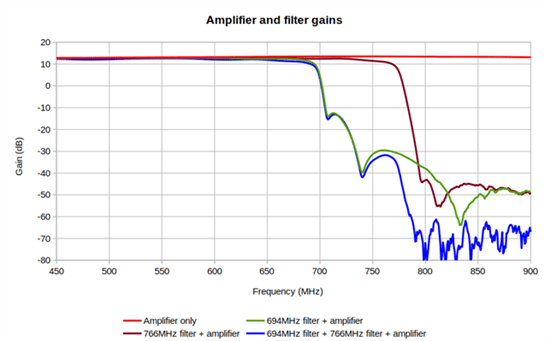
These tests indicate that placing a proLTE5G700 filter before a class 3 or 4 amplifier should also achieve similar results.
Choice of Amplifier
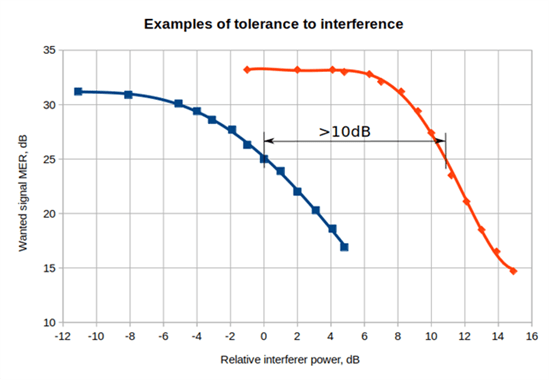
Meeting the minimum requirements of the standard used to show compliance with RED does not necessarily mean that an amplifier can cope with all situations where there is an interfering signal from a network for mobiles. To explore this, Blake UK has conducted tests on two amplifiers: one from another supplier that just meets the standard's requirements (Amplifier 1), and the other a proAMP11 (Amplifier 2).
Both amplifiers were fed a set of off-air signals combined with a locally generated signal representing interference from a mobile phone network. The interference signal could be varied in power, while the MER of one of the off-air signals was measured at the amplifiers' output.
Referring to the graph below, both amplifiers clearly show that as the interference power increases, the MER of the wanted DTT signals initially is unaffected and then decreases. The horizontal axis has been set to zero at an MER of 25 dB for Amplifier 1 (blue line). Looking across to Amplifier 2 (orange line) also at 25 dB MER shows that Amplifier 2 can tolerate over 10 dB more interference than Amplifier 1, for the same level of signal degradation. This is before any filtering has been added.
In summary, both the filter and the amplifier need to be chosen carefully to build a system that is robust against interference.
Examples of amplifiers from the Blake UK range with especially good strong signal handling include proAMP11, proAMP12 indoor amplifiers, and proMHD11L and proMHD14R masthead amplifiers.